
Patagonia with a Toddler and a Grandma — Our Three Week Adventure at the End of the World
There are trips you take and trips that change you. This was the second kind.
Three weeks in Patagonia. Three generations — my mum at 67, me, and Freddy who turned three years old on a boat in the Strait of Magellan surrounded by 120,000 penguins. A trip that most people said was too ambitious, too remote, too much for a toddler.
We did it anyway.
This is the full story of how we did it, where we stayed, what we saw and exactly how you can do it too.
Route
BGI → Panama → Buenos Aires → Ushuaia
Getting Around
Buses between all stops
Duration
3 weeks, Feb
Travel Party
Grandma (67) + Mum + Toddler (3)
The Journey Down — BGI to Ushuaia
Getting to the end of the world is not a quick journey from Barbados. We flew BGI to Panama City, Panama City to Buenos Aires, and then Buenos Aires to Ushuaia — three flights over two days before we even set foot in Patagonia.
It is a long haul. With a toddler. On an overnight connection through Buenos Aires. Pack snacks. Pack more snacks. Accept that sleep on overnight flights with a nearly-three-year-old is more of a suggestion than a guarantee. Arrive knowing that what is waiting for you at the other end is worth every hour of it.
Ushuaia — The City at the End of the World
4 nights
Nothing prepares you for Ushuaia.
It is a small city but it carries a weight that larger places don’t have — the knowledge that beyond it there is nothing but ocean and ice all the way to Antarctica. You feel it the moment you arrive. There is a buzz in the air that is hard to explain and impossible to ignore. Every person you meet is either just back from somewhere extraordinary or about to leave for it. The jumping off point to the white continent. The last city before the end of the earth.
The vibe is distinctly European — alpine architecture climbing up steep hillsides, a working port, restaurants and hostels packed with adventurers from every corner of the world. And the wind. Oh, the wind. Ushuaia is one of the windiest places I have ever stood and I have stood in some windy places. It does not gust — it howls, constantly, as if the landscape is reminding you exactly where you are.
We spent four nights here and it was the right amount of time.
End of the World Train and Tierra del Fuego Park
Our main activity was the End of the World Train combined with a bus tour through Tierra del Fuego National Park. The train is a genuine experience — a narrow gauge railway that once transported prisoners to work in the park, now carrying tourists through some of the most dramatic sub-Antarctic scenery on earth. Freddy was delighted by the train. My mum was delighted by everything.
The bus tour through the park covered the main sites — beaver dams, beech forest, the Beagle Channel coastline — at a pace that worked perfectly for a three year old and a 67 year old in the same travel party. Not every trip needs to be a gruelling hike. Sometimes a bus window and good commentary is exactly right.
The Lighthouse Boat Cruise
The unexpected highlight of Ushuaia was a boat cruise out to the lighthouse on Les Eclaireurs Island in the Beagle Channel. Sea lions draped over rocks like they owned the place, cormorants nesting in the cliffs, and a tiny island where Freddy spent a focused and deeply satisfied twenty minutes throwing rocks into the water. Sometimes the best toddler travel moments are the simplest ones.
💡 Stace’s Tip
Ushuaia rewards slow exploration. The end of the world feeling is real and it deserves a few days. Don’t rush through it on the way to somewhere else.
Punta Arenas — Penguins and a Third Birthday
2 nights
Getting there: Bus from Ushuaia, depart 06:45, arrive 19:00
The bus crossing from Ushuaia to Punta Arenas is a long day — around twelve hours — but the scenery through Tierra del Fuego and across the Strait of Magellan ferry crossing makes it genuinely worthwhile. Crossing from Argentina into Chile felt like entering a different world even though the landscape looked much the same.
Punta Arenas itself was not my favourite stop on the trip. It is a functional port city — perfectly fine, perfectly pleasant — but it does not have the end of the world magic of Ushuaia or the dramatic landscape of what comes next. My honest recommendation is to treat it exactly as we did — arrive, sleep, do the penguin tour, leave. One full day is enough.
We were there for the penguins. And the penguins delivered — on the most perfect day they possibly could have.
Magdalena Island Penguin Colony — Freddy’s Third Birthday
February 10th. Freddy’s third birthday. The day he turned three years old we put him on a boat in the Strait of Magellan and sailed him out to an island covered in 120,000 penguins.
I could not have planned a better birthday if I had tried.
Isla Magdalena is home to around 120,000 Magellanic penguins during breeding season. One hundred and twenty thousand. The island is covered in them — waddling across the path, sitting in burrows, standing at the water’s edge looking deeply unimpressed by everything. You walk a marked path through the colony and the penguins are completely unbothered by your presence. They waddle past your feet. They look up at you with those extraordinary eyes. They carry on with their penguin business as if you are barely worth noticing.
Freddy was completely beside himself.
Watching a newly-turned-three-year-old encounter 120,000 penguins for the first time — on his actual birthday — is one of those parenting moments that lodges itself permanently in your memory. He stood very still — which if you know toddlers you know is remarkable — and just watched them with enormous serious eyes. Then he laughed and pointed and said something that I think was meant to be penguin but came out entirely differently.
He turned three surrounded by penguins in the Strait of Magellan. As far as third birthdays go I feel like we set the bar fairly high.
We went on the 1:30pm sailing which I would recommend — the morning light is beautiful but the afternoon gives you more time to get settled into Punta Arenas before departure.
💡 Stace’s Tip
The Magdalena Island penguin tour is the reason to stop in Punta Arenas. Book it before you leave home — it sells out. The boat crossing takes around two hours each way and can be choppy in the Strait of Magellan. Bring layers regardless of the forecast. And if your child’s birthday happens to fall on the day of the tour — lean into it completely.
Puerto Natales — Gateway to Torres del Paine
1 night
Getting there: Bus from Punta Arenas, depart 08:30, arrive 11:45.
We opted to rent a car.
Puerto Natales is a small town that exists almost entirely as a gateway to Torres del Paine and it does that job beautifully. We spent one night here — enough to resupply, eat a proper meal, do a final kit check and mentally prepare for what was coming.
The town itself has a lovely laid back feel — good restaurants, outdoor gear shops, and a waterfront with views across Ultima Esperanza Sound to the mountains beyond. After the long bus days it was exactly the right pace.
💡 Stace’s Tip
Use your night in Puerto Natales to stock up on any food or supplies for Torres del Paine. The park is remote and expensive — bring what you need from town.
Torres del Paine — The Heart of Patagonia
3 nights
Getting there: Bus from Puerto Natales, depart 06:45, arrive 09:00
I need you to understand something about Torres del Paine before I describe what we did there.
It is not a national park in the way most national parks are a national park. It is something else entirely. The scale is incomprehensible until you are standing in it. The weather changes in minutes — sunshine to horizontal rain to sunshine again before you have finished putting your waterproof on. The landscape feels primeval. Ancient. Like the beginning of the world rather than the end of it.
Day 1 — Arrival and Climb to Chileno Campsite
We arrived in the park in the morning and began hiking immediately toward Campsite Chileno. The trail up to Chileno is relentless — a continuous climb through forest and over rocky terrain with the weight of full packs on our backs and Freddy in the carrier for the steeper sections. My mum at 67 did every step of it without complaint. I want that noted for the record.
Chileno Campsite sits in a stunning position in the valley below the towers. We had booked premium fully equipped campsites — rooftop tents on raised platforms with bedding provided — and after the climb to get there they felt like the most luxurious thing in the world.
That evening we met a group of Canadians at the campsite who became one of my favourite memories of the entire trip. They were warm and funny and completely wonderful with Freddy — playing with him, entertaining him, treating him like a proper fellow traveller rather than an obstacle. These are the people you meet on trail.
Day 2 — The Base of the Towers
This was the day.
We left Chileno early and climbed to the Mirador Las Torres — the lookout at the base of the three famous granite towers that give the park its name. The final section is a steep scramble over glacial moraine and it is hard going. With Freddy in the carrier for the upper section and my mum climbing steadily behind me it was one of the most demanding mornings of the trip.
And then we got there.
The towers rise almost vertically from a turquoise glacial lake — three columns of ancient granite that have been photographed millions of times and still manage to exceed every expectation when you see them in person. We stood there, the three of us plus Freddy, at the base of one of the most iconic landscapes on earth.
On the way up we passed our Canadian friends coming down. They saw us and cheered. Genuinely cheered. The kind of trail solidarity that makes you feel like you are part of something. A few days later when I posted that we had made it, one of the Canadian girls saw it on Reddit. She commented to say she was so happy we had done it. That comment made my day more than I can properly explain.
We descended all the way to Campsite Central that afternoon — a long day by any measure.
Days 3 and 4 — Campsite Central
Campsite Central became my favourite place on the entire trip.
The premium rooftop tents at Central were incredible — elevated platforms with proper bedding, proper mattresses and views of the mountains from your sleeping position that made waking up feel unreasonable in the best possible way. The campsite has a restaurant, hot showers and a warmth about it that Chileno — more exposed and more utilitarian — didn’t quite have.
We spent two nights here and used the time to rest, to eat, to watch the Patagonian weather put on its daily show and to let Freddy run free in a way that trail days don’t allow.
💡 Stace’s Tip
Book the premium fully equipped campsites at Chileno and Central well in advance — they sell out months ahead for the February peak season. The rooftop tents are worth every peso over the basic camping option, especially with a toddler and an older travel companion. The climb to Chileno is harder than it looks on paper. Use the carrier for the steep sections.
Back to Puerto Natales
1 night
Getting there: Bus from Torres del Paine, depart 14:45, arrive 17:05
One night back in Puerto Natales between the park and the next leg. We ate well, slept in proper beds and prepared for the crossing into Argentina.
El Calafate — Glaciers and Blue Ice
4 nights
Getting there: Bus from Puerto Natales, depart 07:45, arrive 13:40
El Calafate is a tourist town built almost entirely around one reason to visit — Perito Moreno Glacier — and that one reason is more than enough.
The town itself is pleasant, well set up for travellers, and has good restaurants and a relaxed feel after the intensity of Torres del Paine. We used it as a base for the glacier and as our jumping off point for El Chaltén.
Perito Moreno Glacier
Perito Moreno is one of the few glaciers in the world that is not retreating and standing in front of it you understand why it commands such reverence. It is 5 kilometres wide, 60 metres high at the face and utterly, completely alive. The ice groans and cracks constantly. Chunks calve from the face and crash into the lake below with sounds like cannon fire. The blue of the ice — a blue that has no equivalent anywhere else — is something no photograph adequately captures.
We did the walkways tour which takes you along a series of elevated catwalks above the shore directly in front of the glacier face. And we did the boat tour which takes you out onto the lake and up close to the ice wall.
The boat tour is essential. Full stop. From the walkways the scale is extraordinary. From the boat it is incomprehensible. You look up at sixty metres of ancient blue ice from a small boat on a glacial lake and you understand in your body rather than your head what you are looking at.
Freddy watched the calving events with the focused attention he usually reserves for construction vehicles. Every crack and crash got a pointed finger and a sound effect. It was perfect.
💡 Stace’s Tip
Do both the walkways and the boat tour if your budget allows. The walkways alone are wonderful. The boat tour takes it to another level entirely. Book through your accommodation the night before.
El Chaltén — Fitzroy Country
4 nights
Getting there: Bus from El Calafate, depart 10:15, arrive 13:10
El Chaltén is my kind of town.
A tiny hiking village at the end of a long road in the shadow of Mount Fitzroy — it exists for one purpose and it does that purpose beautifully. No traffic lights. No shopping centres. Just mountains, trails, good food and people who came here to walk.
We had decided before arriving that we were not attempting Fitzroy itself — the full hike is long, demanding and not right for our travel party on this trip. We made peace with that decision early and it was the right one. El Chaltén rewarded us anyway.
Laguna Capri
Our first hike was Laguna Capri — 8 kilometres out and back with steady climbing through lenga beech forest to a high lake with views back toward Fitzroy. A beautiful trail, manageable for our group, and the kind of hike that reminds you why you came to Patagonia.
Chorillo del Salto — And the Mountain Appears
Our second hike was to Chorillo del Salto — a beautiful waterfall a few kilometres outside El Chaltén, an easy walk on a well-marked trail through the Patagonian landscape.
The day we did this hike the clouds that had been sitting on Fitzroy since we arrived finally cleared. We were not on the Fitzroy trail when it happened. We were walking back toward town when someone pointed and we turned around and there it was — the full jagged silhouette of Monte Fitzroy and Cerro Torre against a blue sky, clear and sharp and extraordinary.
We walked back into town and sat in the playground — Freddy on the swings, my mum and I on a bench — and watched Fitzroy standing perfectly clear above the rooftops. Sometimes the mountain comes to you.
💡 Stace’s Tip
El Chaltén is a free hiking destination — there are no entrance fees for any of the trails, which is extraordinary given the quality of what’s on offer. You do not need to do Fitzroy to have an incredible experience here. Laguna Capri and Chorillo del Salto are both stunning and completely manageable for a mixed ability travel group.
The Journey Home
From El Chaltén we bussed back to El Calafate for a final night before flying Buenos Aires to Panama City to Barbados — the long journey home in reverse. Three weeks at the end of the world. Three generations. One three year old who celebrated his birthday with 120,000 penguins and handled every single day of it like a seasoned traveller.
Practical Information
December – March
February is ideal — long days, good temperatures, park fully accessible. Book everything months in advance.
Buses between all stops
Efficient and well set up for travellers. The Puerto Natales to El Calafate crossing is international — book in advance.
Book before you leave home
Torres del Paine premium campsites sell out months ahead for February. Do not leave this to chance.
More manageable than it looks
Premium campsites are genuinely comfortable, towns are relaxed and Patagonians are wonderful with children. Freddy turned three on this trip and handled every single day of it.
Pace is everything
My mum was 67 and did every step. Choose the right trails, build in rest days, and don’t try to cover too much ground in a single day.
BGI → Panama → Buenos Aires → Ushuaia
Three flights over two days from Barbados. Pack snacks, accept the overnight, know what’s waiting at the other end.
Would We Do It Again?
We would do it tomorrow.
Patagonia is one of those places that gets into your blood. The scale of it, the wildness of it, the way the weather makes you feel genuinely small and genuinely alive at the same time. Three generations at the end of the world — a grandmother, a mother and a three year old who turned three surrounded by penguins in the Strait of Magellan.
If you are sitting there wondering whether Patagonia is possible with a toddler, with your mum, with people in your travel party who are not elite athletes — it is. Plan carefully, book early, pack layers, and go.
The towers will be waiting.
More Toddler Travel
- The Best Toys, Activities and Hacks to Keep Toddlers Entertained While Travelling
- Walking the West Highland Way with a Toddler: A Realistic Day-by-Day Guide
- Minimalist Adventure Packing Guide for Single Moms Travelling with Toddlers
- Patagonia with a Toddler
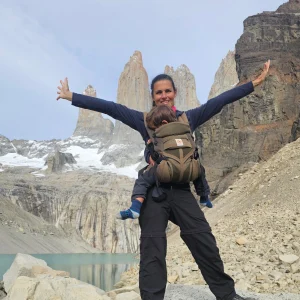
Stacey
Barbadian solo mum, adventure traveller, Freddy’s hiking partner
What's in the bag
Every piece of gear I actually use and recommend.
Toddler Adventure Travel Toolkit
The complete packing, planning and survival guide for travelling with toddlers.